
How to Use AI for Brand Identity Design
Learn how to use AI tools effectively for brand identity design. Discover practical approaches to create consistent, intentional brand visuals with AI assistance.
Not long ago, creating a brand identity meant expensive designers, long timelines, and lots of back-and-forth. Today, AI tools have changed that completely. With the right approach, you can explore ideas, design visuals, and build a clear brand identity much faster. But here's the truth many people miss: AI doesn't magically create a brand for you. It helps you design one if you give it the right direction.
In this article, you'll learn how to use AI for brand identity design in a simple, realistic way. The language is easy, the steps are clear, and the focus is on doing things right—not just fast.
What Brand Identity Design Really Means
Brand identity design is how your brand looks, feels, and is recognized. It's more than a logo. It includes colors, typography style, image treatment, layout rules, and overall personality. A strong brand identity makes people recognize your brand instantly and trust it over time.
AI can help with the design execution part of brand identity, but it cannot decide what your brand stands for. That part still comes from you. The most successful brands use AI as a tool, not as the decision-maker.
Before using any AI, you need clarity. Ask yourself simple questions. What kind of brand is this? Who is it for? How should it feel? Friendly or serious? Modern or classic? Calm or bold? Choose three to five words that describe your brand. These words will guide every AI output you create.
Without this clarity, AI-generated designs often look good but feel generic. With clarity, they start to feel intentional.
How AI Helps With Brand Identity Design
AI is especially powerful at helping you explore brand identity ideas. You can generate moodboards, visual styles, mockups, and design systems much faster than doing it manually.
Image-generation tools can help you discover:
- Color directions that match your niche
- Illustration or photography styles
- Layout structures
- Visual moods that fit your audience
Instead of starting with a logo, it's better to start with overall style. Ask AI to create abstract brand visuals or design inspiration based on your brand personality. Look for patterns, not perfection. Save what feels right and ignore what doesn't.
Once you start seeing consistency in colors, shapes, and mood, your brand identity is beginning to form.
AI can also help with written parts of brand identity, like tone of voice, mission statements, and values. The best way to do this is not to ask AI to "write it for you," but to ask it to clarify or simplify your ideas. This keeps the brand human while benefiting from AI's structure.
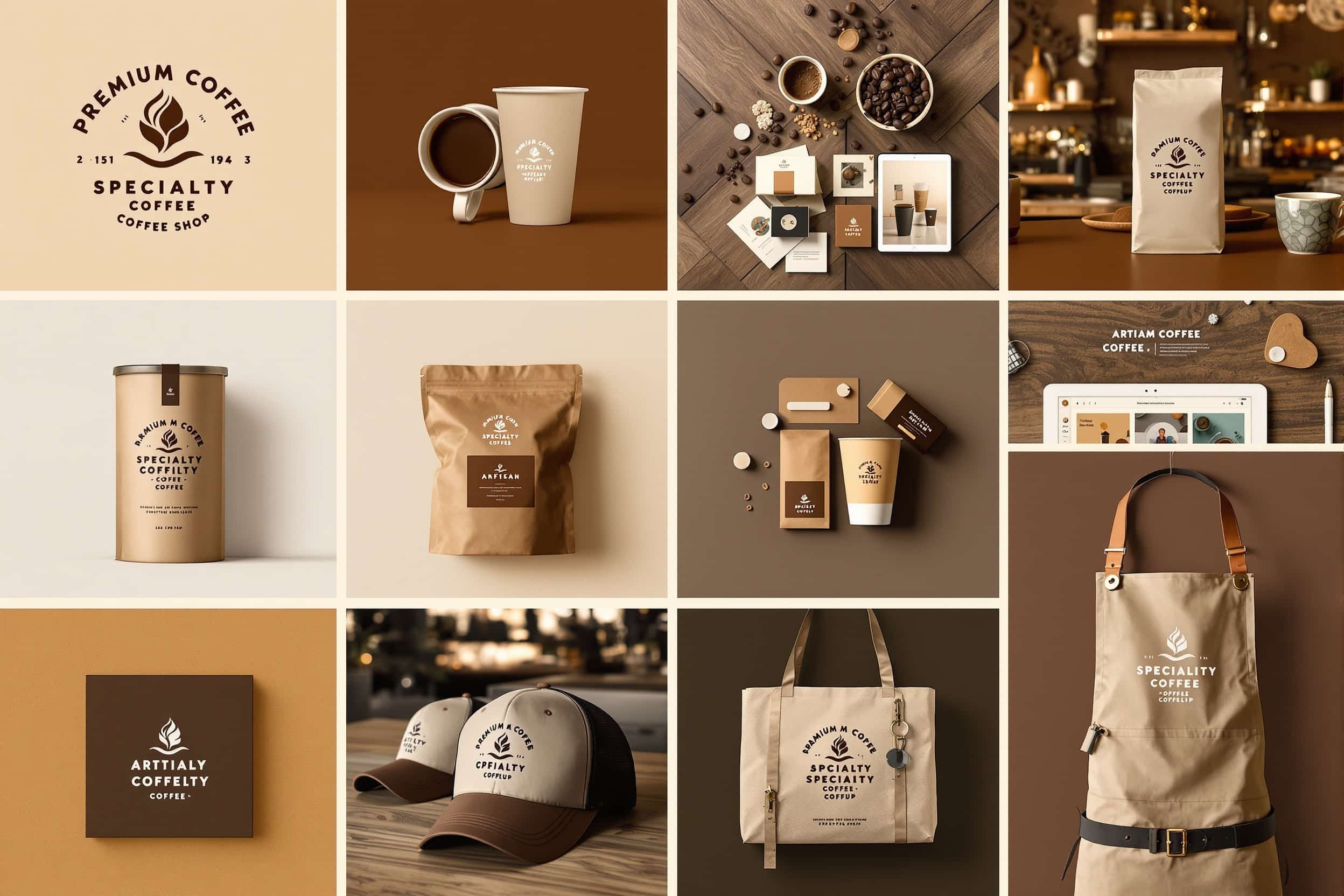
Coffee shop brand identity example created with AI
How to Create a Consistent Brand Identity Using AI
Consistency is the most important part of brand identity design. Many people make the mistake of using different prompts every time they generate something. This causes the brand to feel messy and disconnected.
Instead, once you define your brand clearly, reuse the same descriptions over and over. This becomes your unofficial brand guide for AI. Each time you generate visuals, include the same brand personality, color direction, and style rules.
At this stage, AI can also help you visualize a full brand system. For example, you can use a detailed prompt like the one below to generate a complete brand design guide layout:
Example Brand Design Guide Prompt:
"Create a vertical 9:16 brand design guide poster using the uploaded product image. Adapt the design style to match the product's niche and visual identity. Structure the poster with clear, elegant sections: (1) Large logo display and safe zone usage, (2) Product mockup centered and highlighted, (3) Primary and secondary color palette swatches with hex codes, (4) Typography guide with heading, subheading, body font samples, and line spacing specs, (5) Iconography or graphic motif examples used by the brand, (6) Image treatment style with sample lifestyle or studio visuals, (7) Grid system or layout rules, (8) Packaging mockups and surface applications, (9) Do's & Don'ts with annotated visuals. Use minimalist white or soft neutral background with structured layout dividers and drop shadows. The result must be visually rich, clean, and suitable for a printed or digital brand book."
This kind of prompt shows how AI can help visualize not just individual assets, but a full brand identity system. It's especially useful for presentations, internal guides, or early-stage brand documentation.
Once you have these visuals, review them carefully. Ask yourself if everything feels like it belongs to the same brand. If not, refine your brand description and try again. Brand identity improves through iteration, not one perfect prompt.
Best Practices for Using AI in Brand Identity Design
AI works best when paired with human judgment. Logos generated by AI are great for direction, but final logos should always be refined and cleaned up by a human. Typography choices should be checked for readability and licensing. Colors should be tested across screens and backgrounds.
It's also important to tell AI what your brand should not look like. This is often done through negative prompts, such as avoiding photorealistic images, cluttered layouts, or cartoon styles. Clear boundaries protect your brand identity.
Another important point is originality. AI is trained on existing data, so it tends to produce familiar-looking results if you let it. Original brands come from original thinking. The more specific and intentional you are, the more unique your results will be.
Transparency matters too. You don't need to hide the fact that you use AI. Many brands already do. What matters is that your brand delivers real value and feels consistent and honest.
AI also makes brand identity design more accessible. Small businesses, startups, and creators can now build professional-looking brands without huge budgets. This is powerful, but it also means there are more brands competing for attention. Strong identity and clear messaging matter more than ever.
The future of brand identity design will be a mix of AI speed and human taste. AI will help generate, test, and scale visuals quickly. Humans will decide what feels right, meaningful, and true to the brand.
In the end, AI is not the brand designer—you are. AI is the tool that helps you see your brand more clearly and bring it to life faster. When used with intention and care, AI doesn't replace branding. It makes good branding more possible.
Related Articles
- → How to Create a Brand Identity Using Nano Banana
Learn how to build a complete brand identity using Nano Banana's AI image generation, from concept to consistent visuals.
- → 15 Amazing AI Image Generation Prompts for FotoGenie
Discover powerful prompts optimized for Gemini 2.5 Flash Image (Nano Banana) to create stunning AI-generated images.
- → How to Create Beautiful Close Up Photos with AI
Discover 20 powerful Nano Banana Pro prompts for creating stunning close-up photography.